Short answer: Generative engine optimization (GEO) means shaping your website so that AI answer engines like ChatGPT, Gemini, Perplexity and Google's AI Overviews understand it, trust it and cite it. The research on GEO shows that adding clear statistics, quotations and cited sources can raise a page's visibility in AI answers by up to 40%, while old-style keyword stuffing does not help. Adawaty's Found Everywhere package does this work for you: a $290 audit, then $590/mo.
Key facts
More than 800 million people use ChatGPT every week, according to OpenAI (October 2025).
Google says AI Overviews have more than 2 billion monthly users in over 200 countries and territories (July 2025).
In Pew Research Center's browsing data, Google users clicked a regular result on 8% of visits when an AI summary appeared, against 15% when none appeared.
Ahrefs found that an AI Overview went with a 58% lower click-through rate for the top-ranking page (December 2025 data).
The original GEO study (Princeton and IIT Delhi, KDD 2024) found that citing sources, adding quotations and adding statistics were among the strongest ways to get cited.
Here is the uncomfortable part. Ranking first on Google used to mean you got the click. Now the answer often sits above your link, and the buyer may never scroll. The businesses named inside that answer get the conversation. Everyone else gets an impression that nobody sees.
What is generative engine optimization?
Generative engine optimization is the practice of making your content easy for AI systems to find, understand and quote when they write an answer.
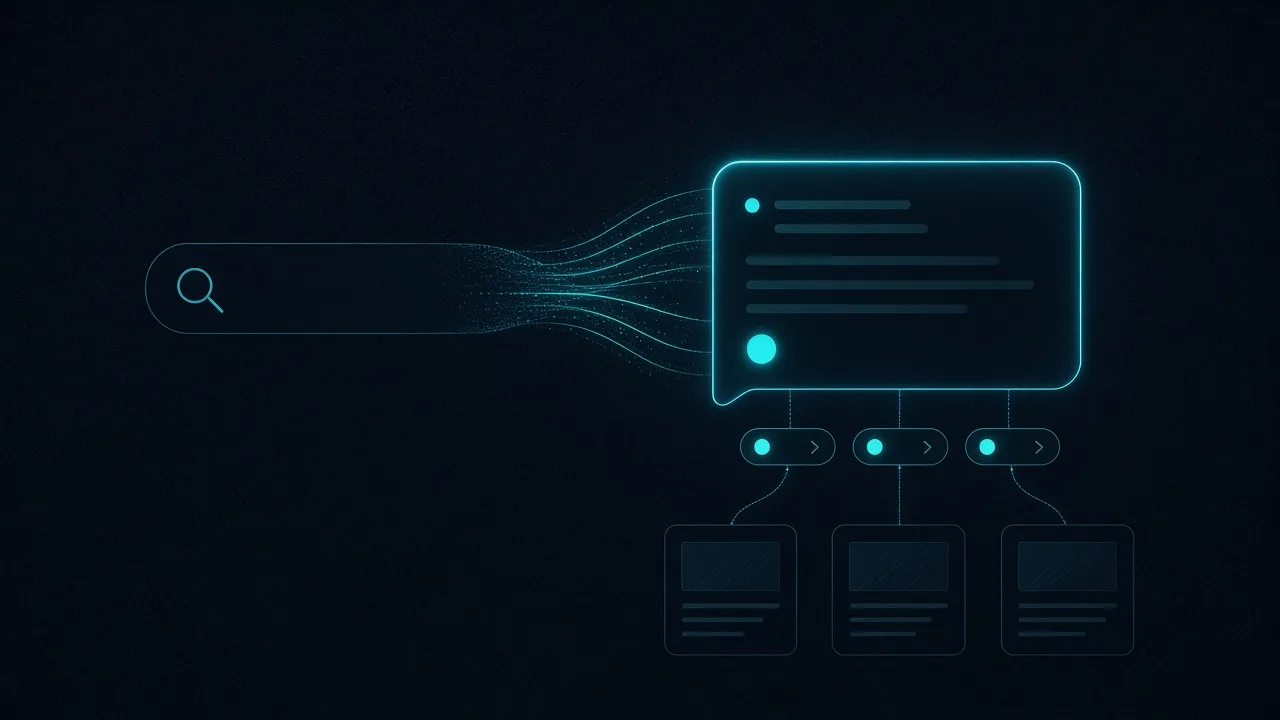
The term comes from a 2023 research paper by Pranjal Aggarwal and colleagues at Princeton University and IIT Delhi, published at the ACM KDD conference in 2024. They describe "generative engines" as systems that search the web, read several sources and write one combined answer with citations. ChatGPT search, Perplexity, Gemini and Google's AI Overviews and AI Mode all work this way.
SEO asks, "Where does my page rank?" GEO asks a different question: "When the AI writes the answer, is my business in it, and is it described correctly?"
Why are fewer buyers clicking through to websites?
Because the answer now comes first. The data from 2025 points the same way:
Pew Research Center tracked 900 US adults' real browsing in March 2025, covering 68,879 Google searches. When an AI summary appeared, people clicked a regular result on 8% of visits, compared with 15% without one. They clicked a link inside the summary on just 1% of visits.
Ahrefs compared 300,000 keywords. In its first study (March 2025 data), an AI Overview went with a 34.5% lower click-through rate for the number one result. When it re-ran the study on December 2025 data, the gap was 58%.
Google reports that AI Overviews reach more than 2 billion people a month, and that AI Mode passed 100 million monthly users in the US and India by mid-2025.
Pew notes its study is observational, and Google disputes the methodology. But the direction is clear. The click is shrinking. Being the source the answer is built from matters more every quarter.
What does the research say gets a business cited?
The GEO paper tested nine ways of rewriting web content on a benchmark of 10,000 real queries, then checked the results on Perplexity, a live answer engine. The findings are useful because they are specific:
Cite your sources. Adding references to credible sources was among the strongest methods.
Add quotations from relevant, credible people or documents.
Add statistics instead of vague claims. "Live in 14 days" beats "fast setup".
Write fluently and simply. Readability changes alone gave a 15–30% visibility lift.
Skip keyword stuffing. On Perplexity it scored about 10% below the unedited page.
The best methods improved visibility by up to 40% in the study's own engine and up to 37% on Perplexity. One more finding stands out for smaller businesses. Sites that ranked lower in classic search gained the most. For pages ranked fifth, the "cite sources" method lifted visibility by 115%. AI answers read your content, not just your backlinks, so a clear, well-sourced page from a small business can compete.
Does Google need special "AI" markup?
No. Google's own Search Central guide says there are no extra requirements and no special schema to appear in AI Overviews or AI Mode. The fundamentals still decide it:
Let Google crawl the page in robots.txt and at your host or CDN.
Link important pages from inside your own site.
Put key facts in real text, not only in images or videos.
Make sure structured data matches what is visible on the page.
Keep your Google Business Profile and Merchant Center details current.
Google also says AI features use a "query fan-out", running several related searches to build one answer. That rewards a site that answers the follow-up questions too: price, timeline, who it is for, and what happens next.
What is coming in 2026–2027?
This section is outlook, not established fact. These are forecasts and trends we are watching:
Answers before searches. In February 2024, Gartner predicted that traditional search engine volume would drop 25% by 2026 as people turn to AI chatbots and virtual agents. It was a forecast, not a measurement, but the 2025 click data above moves in that direction.
Agents that act, not just answer. OpenAI launched apps inside ChatGPT in October 2025. Expect more buyers to compare, shortlist and even book through an assistant. A business the assistant can't read clearly is easy to skip.
Trust signals get heavier. Gartner's same release expects search systems to value content quality, authenticity and expertise more as AI-generated content floods the web.
Bilingual answers win twice. Our view: in Arabic-speaking markets, the business that publishes clear, sourced answers in both Arabic and English first will be easier for AI answers to cite in both languages.
How do you start with GEO this quarter?
Start with what buyers ask, not with keywords:
List the 20 questions buyers ask before they choose you: price, timeline, location, guarantees, comparisons.
Ask the engines. Put those questions to ChatGPT, Gemini, Perplexity and Google. Note who gets named, and what is said about you.
Answer first on your site. One page per key question, with a short, direct answer at the top, then the detail.
Add proof that is real. Numbers, sources and quotes you can stand behind. Never invent them; AI systems and buyers both punish it.
Fix the technical basics. Crawlable pages, fast load, schema that matches the page, a correct business profile.
Re-check monthly. AI answers change. Track whether you are named, and whether the description is right.
How does Adawaty help you get found everywhere?
We do this work for you, end to end. Found Everywhere covers both classic search and AI-assistant visibility:
Audit: we check how Google, ChatGPT, Gemini and Perplexity describe your business today, and where competitors are named instead of you.
Fixes: answer-first pages, structured data, Arabic and English content, and technical clean-up.
Monthly care: we re-check the answers, publish new content and report what changed.
Price: $290 audit, then $590/mo.
Guarantee: on time, or it's on us.
Need the site itself first? Our Launch-Ready Website is $1,490 + $79/mo, and Leads on Autopilot ($290 setup + $390/mo) turns that visibility into a steady lead flow. See every package on our services page.
FAQ
What is the difference between SEO and GEO?
SEO aims to rank your page in a list of links. GEO aims to get your business cited and described correctly inside an AI-written answer. The same technical basics support both, but GEO puts more weight on direct answers, real statistics and cited sources.
Can a small business appear in ChatGPT or Google AI Overviews?
Yes. In the GEO study, lower-ranked sites gained the most from adding sources and statistics. Google also says there are no special requirements beyond being indexed and eligible to show a snippet.
Do I need an llms.txt file or special AI schema?
For Google, no. Its Search Central guide says you don't need new machine-readable files, AI text files or special schema to appear in AI Overviews or AI Mode. Structured data should simply match the visible page.
How much does Adawaty's Found Everywhere cost?
A $290 audit, then $590 per month for ongoing search and AI-assistant visibility work.
Related notes
Sources
Aggarwal, P., Murahari, V., Rajpurohit, T., Kalyan, A., Narasimhan, K., Deshpande, A. "GEO: Generative Engine Optimization." KDD 2024. arXiv:2311.09735
Pew Research Center, "Google users are less likely to click on links when an AI summary appears in the results," July 22, 2025. pewresearch.org
Ahrefs, "AI Overviews Reduce Clicks by 34.5%." ahrefs.com
Ahrefs, "Update: AI Overviews Reduce Clicks by 58%." ahrefs.com
Google, "Q2 earnings call: CEO's remarks," July 23, 2025. blog.google
TechCrunch, "Sam Altman says ChatGPT has hit 800M weekly active users," October 6, 2025. techcrunch.com
Google Search Central, "AI features and your website." developers.google.com
Gartner, "Gartner Predicts Search Engine Volume Will Drop 25% by 2026, Due to AI Chatbots and Other Virtual Agents," February 19, 2024. gartner.com
Want to know what AI says about you today?
Send us your business name on WhatsApp and we'll tell you how ChatGPT and Google describe you, and who they name instead.
Start on WhatsApp