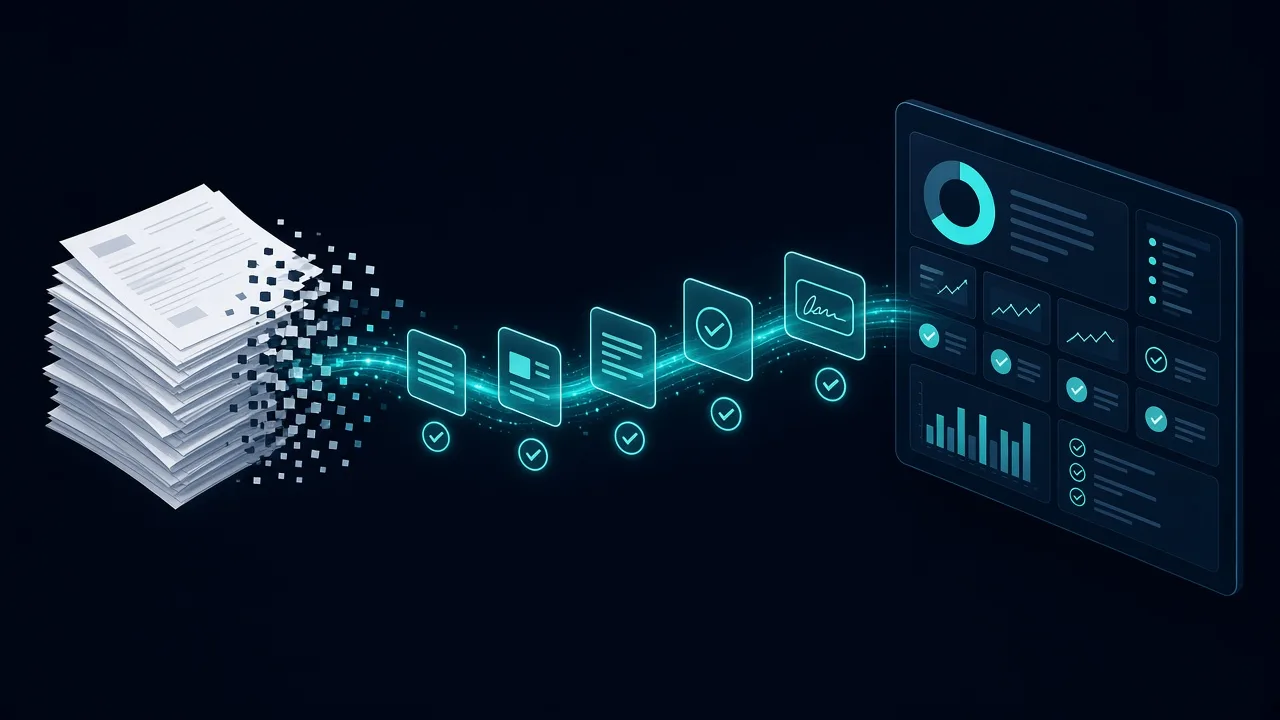
Short answer: AI workflow automation pays off when it targets frequent, rule-based work and keeps a human in charge of judgment calls. In a study of 5,172 customer-support agents, AI assistance raised issues resolved per hour by 15%, and by 30% for less experienced staff. But Gartner predicts that over 40% of agentic AI projects will be canceled by the end of 2027. The difference is scope. Adawaty's Paperless Operations Sprint automates 3 to 5 of your repetitive workflows end to end: results in 3 weeks, $1,890 + $190/mo.
Key facts
Brynjolfsson, Li and Raymond (Quarterly Journal of Economics, 2025): AI assistance raised customer-support productivity by 15% on average and by 30% for less experienced, lower-skilled workers.
Noy and Zhang (Science, 2023): ChatGPT cut the time professionals spent on writing tasks by 40% and raised output quality by 18%.
Dell'Acqua and colleagues (Harvard Business School and BCG, 758 consultants): on tasks inside AI's abilities, AI users finished 12.2% more tasks, 25.1% faster, at more than 40% higher quality. On a task outside them, they were 19 percentage points less likely to get it right.
McKinsey (2023): generative AI could add $2.6 trillion to $4.4 trillion a year across 63 use cases.
Gartner (2025): over 40% of agentic AI projects will be canceled by the end of 2027, and only about 130 of the thousands of "agentic AI" vendors are real.
Every organization has a back office that nobody sees: forms, approvals, reminders, data entry, follow-ups. It rarely breaks loudly. It just slows everything down, a few minutes at a time. AI can now take over much of that work. The research says it works, and it also says exactly where it fails.
What is an agentic back office?
An agentic back office is one where software agents carry out routine operational steps on their own, such as reading a form, updating a record, sending a reminder or routing an approval, and hand exceptions to a person.
Gartner draws a useful line between three tools:
Assistants for simple retrieval, like answering "what is our refund policy?"
Automation for routine workflows with clear rules.
Agents for steps that need a decision.
Most of the value in a typical office sits in the first two. You don't need an autonomous agent to stop people re-typing the same data into three systems.
What do real studies say about AI at work?
These are peer-reviewed or field studies, not vendor claims.
Customer support: 15% more issues resolved per hour
Erik Brynjolfsson, Danielle Li and Lindsey Raymond studied the staged rollout of a generative AI assistant to 5,172 customer-support agents. Access to AI raised the number of issues resolved per hour by 15% on average. Less experienced and lower-skilled agents gained the most, around 30%, which the authors read as the tool spreading the habits of the best performers. Customers were also more polite and less likely to ask for a manager.
Writing tasks: 40% faster, 18% better
Shakked Noy and Whitney Zhang gave 453 college-educated professionals writing tasks from their own fields, such as press releases, reports and emails. Those with access to ChatGPT took 40% less time, and independent evaluators rated their work 18% higher in quality.
Knowledge work: big gains inside the frontier, losses outside it
A team from Harvard Business School, Wharton, MIT and Boston Consulting Group ran a preregistered experiment with 758 BCG consultants. On 18 realistic tasks within AI's capabilities, consultants using GPT-4 completed 12.2% more tasks, worked 25.1% faster and produced work rated more than 40% higher in quality. But on one task designed to fall outside AI's abilities, AI users were 19 percentage points less likely to reach the correct answer.
That is the most important finding for any automation project. AI's abilities are uneven, a "jagged frontier". It is excellent at some tasks and confidently wrong at others. Good automation maps the frontier before it hands over the work.
What happens when companies automate too far?
Klarna is the best-known public case. In February 2024, the payments company said its AI assistant handled two-thirds of customer service chats in its first month, 2.3 million conversations, with average resolution times under 2 minutes.
In May 2025, Klarna changed course. CEO Sebastian Siemiatkowski told Bloomberg that cost had been "a too predominant evaluation factor" and that "what you end up having is lower quality." Klarna began recruiting human agents again and said customers should always be able to reach a person. A spokesperson said the AI still handles two-thirds of inquiries.
The lesson isn't that AI failed. It's that the handoff to humans was designed too thin. Routine work went to AI successfully. Complex and emotional moments still needed people.
Why do so many agentic AI projects fail?
Gartner's June 2025 forecast names three reasons projects get canceled: escalating costs, unclear business value and inadequate risk controls. It adds two warnings:
"Agent washing": many vendors rebrand chatbots, assistants or robotic process automation as "agents". Gartner estimates only about 130 of the thousands of agentic AI vendors are real.
Wrong use cases: "Many use cases positioned as agentic today don't require agentic implementations," said Gartner analyst Anushree Verma.
Gartner recommends rethinking workflows from the ground up rather than bolting agents onto legacy systems, and pursuing agentic AI only where it delivers clear value.
Which workflows should you automate first?
Put the research together and a clear rule appears. Automate work that is frequent, rule-based and easy to check. Keep humans on judgment, exceptions and relationships.
Good first candidates:
Intake forms that get re-typed into a spreadsheet or system.
Approvals that wait in someone's inbox: leave, purchases, refunds, enrolment.
Document collection and reminders, the same lesson Georgia State's admissions chatbot proved.
First-draft content: product descriptions, social captions, short videos and reply templates, where Noy and Zhang's 40% time saving applies.
Lead follow-up, so no enquiry waits until Monday.
Poor first candidates: anything where a wrong answer is costly and hard to spot, or where the customer is upset.
What is coming in 2026–2027?
This section is outlook, not established fact:
Agents inside the tools you already use. Gartner predicts 33% of enterprise software applications will include agentic AI by 2028, up from less than 1% in 2024, and that at least 15% of day-to-day work decisions will be made autonomously by then.
A shake-out. If Gartner's 40% cancellation forecast holds, 2026 and 2027 will separate narrow, measurable projects from expensive experiments.
Paperless as the foundation. Our view: agents can only act on information they can read. Organizations that move forms, approvals and records into clean digital workflows now will be the ones able to add agents safely later.
How does Adawaty help?
We pick the right workflows, build them and run them, with a human handoff designed in from day one:
Paperless Operations Sprint: we automate 3 to 5 repetitive workflows end to end, with smart forms, e-signatures, approvals, error alerts and a runbook. Results in 3 weeks, $1,890 + $190/mo.
AI Video Engine: short-form video content produced with AI, first videos in 7 days. $290 setup + $490/mo.
Leads on Autopilot: every enquiry captured and followed up automatically. $290 setup + $390/mo.
Guarantee: on time, or it's on us.
See every package on our services page.
FAQ
What is the difference between automation and agentic AI?
Automation follows fixed rules, such as "when this form arrives, create a record and notify finance." Agentic AI makes decisions within a task, such as deciding whether a document is complete. Gartner suggests using automation for routine workflows and agents only where a decision is truly needed.
How much productivity can AI really add?
In published field studies, gains ranged from 15% more issues resolved per hour in customer support to 40% less time on writing tasks. Results depend on the task. On work outside AI's abilities, people using AI did worse.
Will AI automation replace my admin staff?
The evidence points to augmentation. The biggest gains went to less experienced workers, and Klarna's experience shows customers still need a human for complex issues. We design every workflow with a clear handoff to your team.
How long does Adawaty's Paperless Operations Sprint take?
Results in 3 weeks, for $1,890 plus $190 per month.
Related notes
Sources
Brynjolfsson, E., Li, D., & Raymond, L. (2025). "Generative AI at Work." The Quarterly Journal of Economics, 140(2), 889–942. academic.oup.com · NBER working paper
Noy, S., & Zhang, W. (2023). "Experimental evidence on the productivity effects of generative artificial intelligence." Science, 381. science.org
Dell'Acqua, F., et al. (2023). "Navigating the Jagged Technological Frontier: Field Experimental Evidence of the Effects of AI on Knowledge Worker Productivity and Quality." SSRN
McKinsey & Company (2023). "The economic potential of generative AI: The next productivity frontier." mckinsey.com
Gartner, "Gartner Predicts Over 40% of Agentic AI Projects Will Be Canceled by End of 2027," June 25, 2025. gartner.com
CX Dive, "Klarna changes its AI tune and again recruits humans for customer service," May 9, 2025. customerexperiencedive.com
Bloomberg, "Klarna Turns From AI to Real Person Customer Service," May 8, 2025. bloomberg.com
Ready to take the busywork off your team?
Tell us the three tasks your team repeats most, on WhatsApp, and we'll tell you which ones to automate first.
Start on WhatsApp